
Plant database
A living library of African indigenous food plants — growing guides, nutritional profiles, local names, and market potential. Updated as the Shiriki pilot farm generates field data.
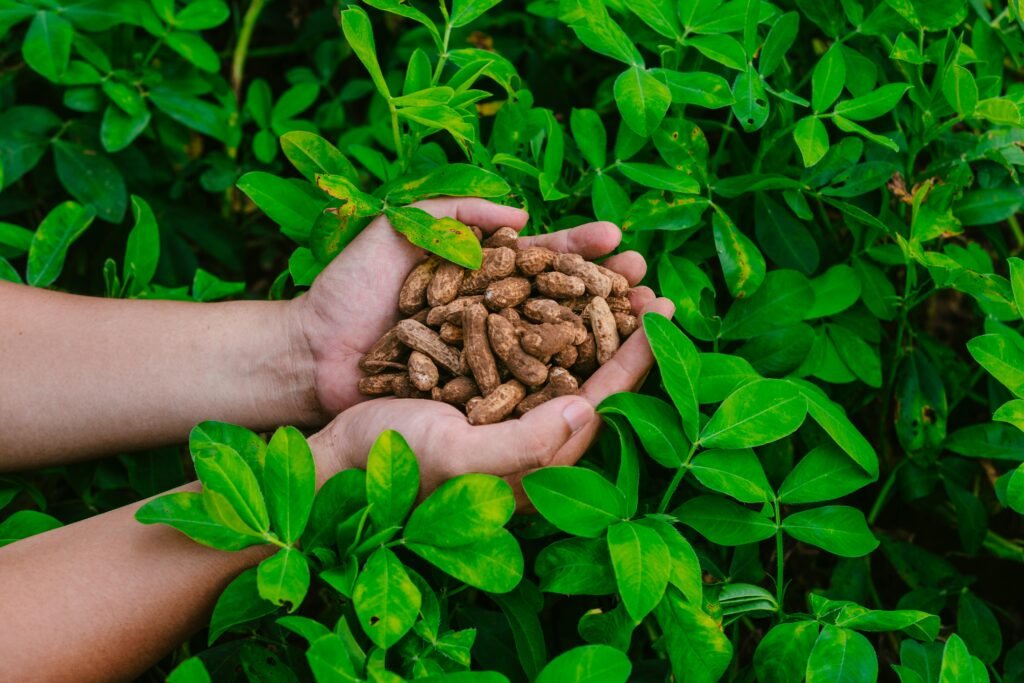
Legume · Underground
Bambara groundnut
Vigna subterranea
Africa's "complete food" — the underground legume that fixes nitrogen, tolerates drought, self-seeds after harvest, and contains a nutritionally balanced ratio of protein, carbohydrate, and fat in a single seed.
About this crop
Bambara groundnut is the third most important grain legume in semi-arid Africa after cowpeas and groundnuts — grown by hundreds of thousands of subsistence farmers from Nigeria to Malawi, South Africa, and Zimbabwe. It is called Africa’s “complete food” because it contains an unusually balanced ratio of protein (18–24%), complex carbohydrate (63–65%), and fat — meaning it can sustain a person nutritionally in a way that few single crops can. It also contains essential amino acids including lysine, which is often deficient in cereal-dominant diets.
Like peanuts, bambara groundnut develops its pods underground from flowers that form on the surface and then “peg” down into the soil. This makes it interesting to observe, somewhat challenging to harvest, and entirely self-seeding — some pods always remain in the soil and will sprout in the following season without replanting. This is the “self-planting” quality that makes it particularly valuable for smallholder farmers with limited seed budgets.
Growing guide
Bambara groundnut is a warm-season crop that needs heat to germinate — optimal soil temperature for germination is 30–35°C. In Gauteng, this means spring planting (September–October) when soils warm up after winter. Do not plant in cool soil — germination will be poor and seeds may rot.
It grows well in poor, sandy soils with low fertility — in fact, it performs poorly in highly fertile soils where it produces abundant leafy growth at the expense of pod yield. Sandy loam with good drainage is ideal. pH 5.0–6.5. Space plants 20–30cm apart in rows 60cm apart. Do not over-irrigate — it tolerates dry conditions well and waterlogging kills it.
Harvest when soil is relatively dry — 3–6 months after planting depending on variety. Pull the whole plant and allow to dry in the sun for a few days before removing pods. Always do a secondary soil check with a fork or rake — pods that break off at harvest remain viable in the soil.
Culinary uses
Fresh green bambara nuts can be boiled or roasted like fresh peanuts. Dried nuts are boiled, roasted, or ground into flour for porridge, dumplings, and baked goods. Bambara milk — made by blending soaked bambara nuts with water — is nutritionally superior to soy milk and is used as a weaning food across much of Africa. In South Africa, jugo beans are sold cooked and salted as a snack, particularly in Limpopo, KZN, and at Bryanston Organic Market.