
Plant database
A living library of African indigenous food plants — growing guides, nutritional profiles, local names, and market potential. Updated as the Shiriki pilot farm generates field data.
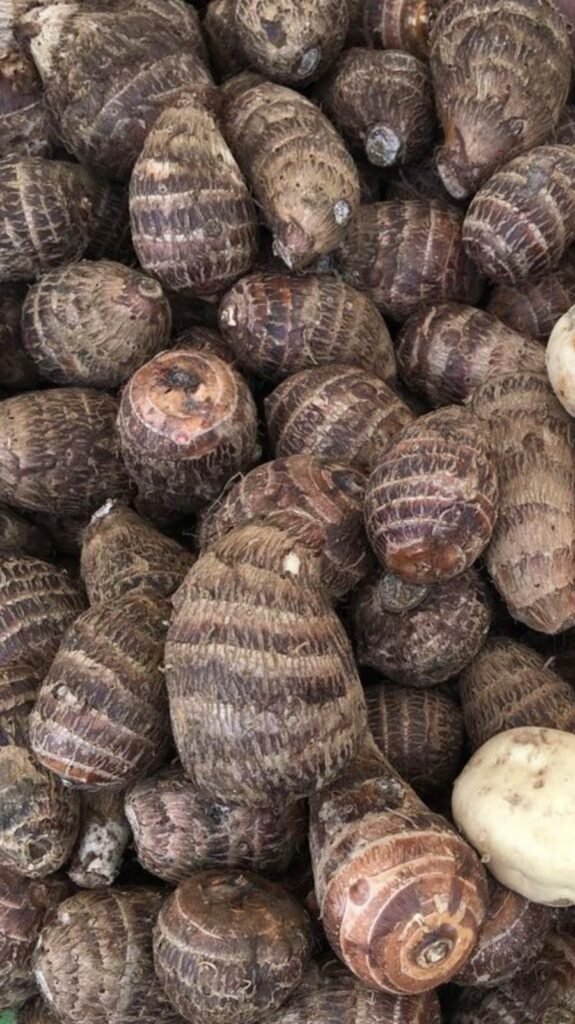
Tuber · Root crop
Amadumbe
Colocasia esculenta
The potato of the tropics — with nine times the protein, a lower glycaemic index, and the ability to grow where commercial potatoes fail.
About this crop
Amadumbe is one of the most nutritionally complete root crops in the world, and one of the most underutilised in South Africa’s formal food system. Grown in southern Africa since the 1500s — introduced by Portuguese traders and later by Indian indentured labourers — it has been a staple of KwaZulu-Natal food culture for generations, and is increasingly recognised by chefs and food researchers as a premium, heritage ingredient.
It is a herbaceous tropical crop that produces a large, starchy corm (the primary edible part) as well as edible leaves. The corm has a rich, earthy flavour, naturally creamy texture when cooked, and a nutritional profile that significantly outperforms the commercial potato in almost every dimension. The Slow Food Foundation has listed amadumbe on its Ark of Taste — a recognition of cultural and culinary heritage that only strengthens its market positioning.
In raw form, amadumbe contains calcium oxalate crystals that cause mouth and throat irritation. Cooking — boiling, roasting, steaming — completely neutralises this. It should never be eaten raw.
Growing guide
Amadumbe is propagated from corms (the tuber itself), not from seed. Plant a whole small corm or a section of a larger corm with at least one visible growth bud. Place cut-side down, approximately 15cm deep, in moist, compost-rich soil. Space plants 60cm apart with 1 metre between rows.
It prefers semi-shade but tolerates full sun with adequate irrigation. It loves moisture — it can grow in waterlogged or riparian areas where most crops fail. It cannot tolerate frost; in Gauteng, plant in a tunnel or wait until September when soil is warm. In the ground from April (in a tunnel): expect harvest by January–February. Spring planting (September): harvest by May–July the following year.
Leaves are harvestable from approximately 3 months — pick outer leaves and the plant continues to produce. Corm harvest is at 8–10 months, when leaves begin to yellow. Dig carefully with a spade to avoid damaging the corms. Clean, sort, and store in a cool dry place.
Dual use — corm and leaves
The corm is the primary commercial product — boiled, mashed, roasted, fried into chips, or made into flour. Amadumbe flour is gluten-free and highly digestible, making it an excellent weaning food and suitable for people with coeliac disease. In West Africa (where it is called cocoyam or ede), it is used to make fufu, mpotompoto (a baby food), and various stews. In KwaZulu-Natal, it is traditionally mashed or served alongside stews.
The leaves — locally called “kontomire” in Ghana — are edible and nutritious, cooked like spinach. In KwaZulu-Natal Indian communities, the leaves are used to make puri patta: spread with spiced batter, rolled, steamed, sliced, and fried. A versatile, culturally rich ingredient that most South African chefs have never worked with.